
Written by Amṛtavāṇī Devi Dasi
The term “Vyāsa-pūjā” literally means worship of Śrīla Vyāsadeva, the guru who disseminated Vedic knowledge for the upliftment of humanity. It is the occasion on which the genuine representative of Śrīla Vyāsadeva is honoured.
The Supreme Personality of Godhead, Śrī Kṛṣṇa, is the original guru, who first imparted the truth through the sound of His flute to Brahma, who in turn imparted it to Nārada, who instructed Śrīla Vyāsadeva, who then disseminated this knowledge through an ever cascading flow from gurus to disciples in the disciplic succession.
In this glorious commemoration, the entire disciplic succession up to Śrīla Vyāsadeva is worshipped. As our spiritual master is a bona fide representative of Vyāsadeva, we take this opportunity to contemplate the great treasure trove of gifts he has benedicted us with, and express our heartfelt appreciation in worship.
The principle of accepting a spiritual master is essential in spiritual life, and we are fortunate that the pure teachings of Śrī Kṛṣṇa have reached us and impacted our lives in a very personal way through the mercy of Śrīla Kadamba Kanana Swami.
Vyāsa-pūjā will be significant to us for different reasons. For some, it is a remembrance of the deep fatherly care of one who is undoubtedly our ever well-wisher; for others, the focus may be on appreciating the one who made the presence of Śrī Kṛṣṇa and the spiritual world so much more tangible, while still being so practically present in our lives. But for all of us, the Vyāsa-pūjā is significant because it is a celebration of connection – the connection to Śrī Śrī Rādhā Kṛṣṇa, which is almost impossible to attain without this mercy of Their most confidential servitors.
It is inconceivable really, what this connection means and I have no qualification to properly describe it. But I stand humbled by the knowledge that Kadamba Kanana Swami has given me the opportunity to serve Śrīla Prabhupāda, Lord Caitanya and Rādhā Kṛṣṇa, and that nothing in the world can actually make him withdraw his mercy. The guru is always committed to delivering us conditioned souls, and not just delivering us from birth and death, but giving us access to the full experience of love of God. Śrīla Prabhupāda says, “Our only shelter is the Supreme Lord, and one who teaches how to approach Kṛṣṇa is the functioning form of the Personality of Godhead. There is no difference between the shelter-giving Supreme Lord and the initiating and instructing spiritual masters.” (Śrī Caitanya-caritāmṛta Ādi-lila 1, text 47, purport)
Kadamba Kanana Swami is an ocean of transcendental qualities. We remain inspired by his personal approach and his ability to see each person as an individual with the potential to serve Kṛṣṇa in a unique way. He was not one to focus on our many inadequacies, often stating that in Kali-yuga, weakness is our birthright. He simply kept us close to the mercy, knowing that in time, the process of Kṛṣṇa consciousness will purify us. He carved out a space for even the most eccentric, having full faith that simply connecting to Śrīla Prabhupāda’s movement will bring us closer to our eternal identity as a servant of Kṛṣṇa, and in the process, shed off our many false designations. With complete compassion, and with joy in this mission, he invested his time, energy and resources, showing us the next steps in the path toward spiritual realization. And this guidance is ongoing, forever present in the legacy he leaves behind.
How can we properly express our gratitude to the one who has connected us with our true lineage and placed us on the path back home, while we were wandering as vagrants in this world? How can we properly worship the one who saw us as we truly are – souls who by nature are blissful, eternal and knowledgeable – when our lifestyles and attitudes express the exact opposite?
He reminds us, “Worship of the spiritual master goes beyond offering flowers or incense. It is in every action that we worship the spiritual master.” (Guru and Disciple: Awakening spiritual vision). He emphasized that worship of the spiritual master goes beyond one’s personal worship to the point of really pleasing the spiritual master.
So Vyāsa-pūjā is an opportunity for us to think about the next step, whether it is in some new commitment, a greater service, a more magnanimous offering to the most magnanimous personality, the one who opens the doors of the spiritual world for us and continues to give us glimpses of it’s ever expanding and blissful nature.
Prior to coming to Kṛṣṇa consciousness, we may have heard, “God is justice” or “God is peace,” and of course, “God is love”. But our spiritual master taught us that God is “a certain blissful personality” (Wonderful Kṛṣṇa), and in his presence and especially his kirtanas, he gave us direct experience of this bliss. We were often transported above the bodily platform, having glimpses of the spiritual world, where every word is a song, every step is a dance, and every day a festival of glorification. He brought home the words of His Holiness B.R. Sridhar Swami, who stated, “You are a child of immortal nectar. You were born in nectar, born to taste nectar, and should not allow yourself to be satisfied with anything but nectar.” (The Search For Sri Krishna: Reality the Beautiful)
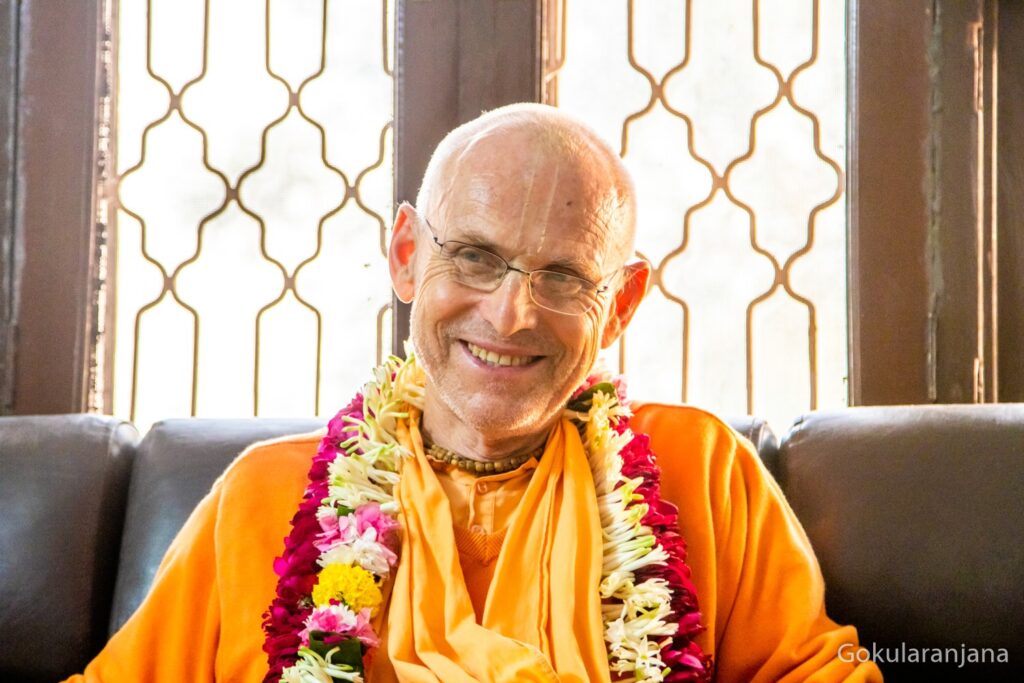
Where do we go for nectar now in the physical absence of the spiritual master?
We go to the community of his disciples and friends, all of whom have captured his spirit in some way. By hearing about, remembering, and serving our spiritual master together, especially during this most auspicious occasion of his Vyāsa-pūjā, we can know and appreciate him more deeply, and once more taste the nectar of his association.
We also go to his instructions, and reaffirm our commitment to following them. In Guru and Disciple, Awakening Spiritual Vision, Kadamba Kanana Swami writes, “We are very much on the receiving end, but after the disappearance of the spiritual master, the crux of our relationship is what we offer to the spiritual master. It is there that we are again strongly reconnecting and we can feel that connection coming to life. My appeal to you is to please carry on in this mission of spreading Kṛṣṇa consciousness. Assist me in this movement, creating space for individuals to be human and express a human nature while keeping loyal to spiritual principles. Assist me whether I'm here or not and if you do that, then I will be there.”
He created a safe space for everyone, and here reminds us that he is still present, especially when we imbibe this family spirit of kindness and deep care while actively serving the movement. In attempting to follow this mood, we take shelter of all the great saintly personalities he held close, especially Śrīla Prabhupāda, whose teachings he embodied and whose mission was his life and soul.
In Forever Present, Kadamba Kanana Swami says, “You became my disciples to become pure devotees, nothing less. That’s what you are supposed to be; that’s what it means to be a disciple; that’s what I would like.”
His uncompromising dedication to pure devotional service is expressed in all his words. Yes, he was understanding; yes, he was compassionately tolerant of our weaknesses, but his final instruction was that we become pure devotees. And although we may be intimidated by this lofty goal, we are simultaneously nourished by his mood that it is mercy and the prayer of the pure devotee that eventually carries us. So let us do something to conquer his heart again and again, and attract his mercy again and again. As mentioned in the Garga-saṁhitā, “It is the saint and not the sun that removes the darkness in the hearts of men.”
He often quoted Śrīla Prabhupāda who wrote:
“Actually the mercy of the bona fide spiritual master is there equally for everyone, just like the sun is shining equally everywhere. Yet there are those who refuse to come out completely into the light.”
[Letter from Śrīla Prabhupāda to Gurukrpa, Bombay, March 30, 1971]
On this occasion of Vyāsa-pūjā, let us step into the light of the spiritual master boldly, with greater faith and trust, knowing that we have his mercy and prayer. Let us take even one instruction and carry it on our head like a śiromaṇi. And most of all, let us bow down perpetually in our hearts to that saint who came our way to show us an ideal life of service to Kṛṣṇa in love.